Cash feels comforting. It sits quietly in your bank account, doing exactly what you expect it to do. It doesn’t fluctuate, it doesn’t send alarming notifications, and it doesn’t surprise you when markets get messy. One dollar today will still be one dollar tomorrow, and something is reassuring about that kind of certainty.
The habit of saving cash is drilled into us early. Put money aside. Don’t take risks. Make sure there’s something there, just in case. Watching a savings balance grow feels responsible and sensible, because it looks solid and dependable, untouched by market swings or unsettling headlines. In a narrow sense, that comfort makes perfect sense. Cash won’t vanish overnight, and it won’t show up one morning down 8% for reasons you don’t fully understand.
The problem with cash isn’t that it disappears. It’s that while it stays exactly the same, the world around it doesn’t. Things get more expensive over time, but a dollar will always remain a dollar.
That illusion of safety is something Laura Suter, Director of Personal Finance at AJ Bell, encounters all the time. People take comfort in knowing they won’t lose money in cash. What’s far less intuitive is the idea that doing nothing can still carry risk, and that inflation quietly eats away at the real value of savings year after year.
Inflation doesn’t stand out as a headline event in most people’s lives. People usually notice it in smaller, more ordinary ways. Like seeing the weekly shop cost a little more than it used to. Rent nudges higher. Insurance renewals creep up. Healthcare, education, and other essentials slowly become more expensive.
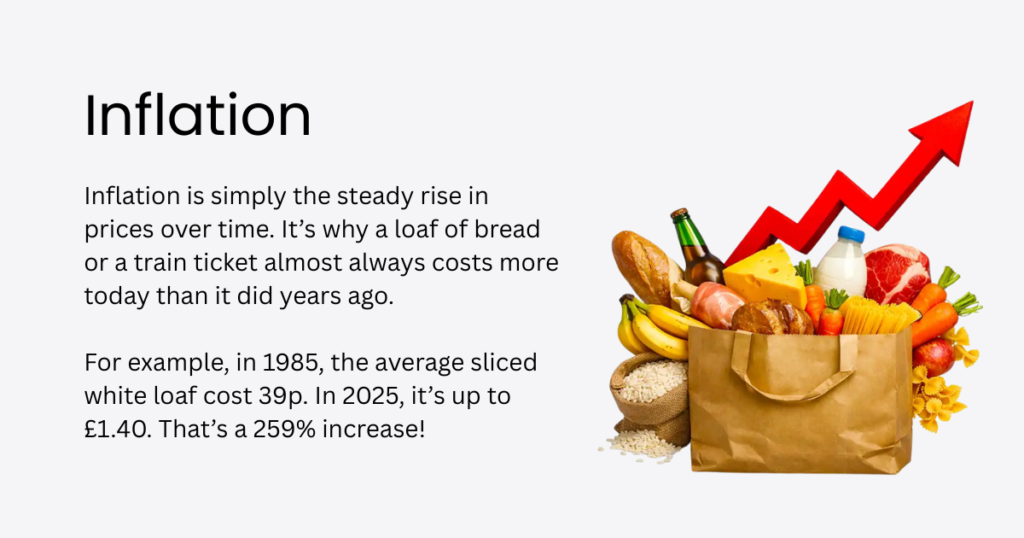
If inflation is running at 3% and your savings are earning 2%, your money is shrinking in real terms, even though the number on your screen hasn’t changed at all.
This is where we come back to purchasing power. Money isn’t valuable because of the symbol printed on it, but because of what it allows you to buy. When prices rise faster than your savings, your purchasing power falls, even though your cash remains numerically the same.
That loss of purchasing power is easy to ignore in the short term, which is what makes it so dangerous. Over longer periods, it can quietly derail even well-intentioned financial plans. Suter often points to the fact that millions of people hold large sums in cash ISAs while having no exposure to investments whatsoever. On paper, they look cautious and disciplined. But the reality is, much of that money is sitting still while inflation steadily pulls ahead.
Time is the enemy here. Even low levels of inflation compound relentlessly when given enough years. At 2% inflation, £10,000 loses close to a fifth of its purchasing power over a decade. At 4% or 6%, which history shows is far from unusual, the damage accelerates quickly.

The same savings can be worth barely half as much in real terms within a couple of decades. Nothing has been taken from you or changed, but what that balance can actually do has.
Some people might try and argue that higher interest rates solve this problem. They can help to a degree, but historically, it's hard to call them a reliable defence considering they are highly dependent on the economic cycle. Savings rates tend to rise because inflation is already elevated, and they don’t stay attractive indefinitely.
Looking back over long periods of history, cash has beaten inflation only around 60% of the time, regardless of whether money was held for one year or ten. Relying on cash alone to preserve wealth is, effectively, a coin toss.
Investments, by contrast, are imperfect but powerful when given the power of time. Shares, bonds, property, and other assets are more volatile on paper, but all have the potential to grow in different ways and at different moments. These assets offer something cash cannot: a reasonable chance of keeping pace with (and often exceeding) inflation over the long term. Not smoothly or without volatility, but far more reliably over decades.
The reason so many people hold the vast majority of their wealth in cash has less to do with maths and more to do with emotions. Investing can feel complicated and intimidating. You don't get caught in the drama of market crashes and bearish cycles. Meanwhile, your cash losses are completely silent.
Holding large amounts of cash might feel safe, but it comes with risks that many investors overlook. The hidden cost of holding cash lies in its inability to grow over time, especially when inflation erodes purchasing power. While keeping cash on hand can provide liquidity for emergencies, excessive amounts can quietly diminish wealth, leaving investors behind compared to those who allocate funds to investments with higher returns.
People also worry they need perfect timing, deep expertise, or large sums to get started. What matters far more in reality is staying invested long enough for compounding to work. Trying to jump in and out usually backfires. Fear pushes people to sell when markets fall and re-enter only once things feel safe again, often locking in losses and missing recoveries.
None of this means cash has no place, because it absolutely does and probably always will. Most people are rightly advised to keep several months of essential expenses readily available in cash, because that buffer provides flexibility in case something unexpected shows up in life.
The risk lies in holding large amounts of cash for years beyond what’s needed for security. It can mean giving up growth and compounding, the two forces that make long-term wealth possible. Over time, the cost of that caution can be enormous.
Another aspect of the hidden cost of holding cash is the missed opportunities for growth. Money kept idle in savings accounts or under the mattress does not benefit from compounding interest, dividends, or market gains. Over years, this opportunity cost can add up significantly, reducing the long-term potential of your portfolio and limiting your financial goals.
Saving money feels responsible, and often it is. But saving only in cash, and doing so for the long term, can quietly undermine the very goals that saving was meant to support. Cash doesn’t shout when it’s losing value. It doesn’t issue warnings or demand attention. It simply becomes less capable, year after year, while appearing unchanged.
Financial experts suggest balancing liquidity with investment strategies to minimize the hidden cost of holding cash. Diversifying into stocks, bonds, or other assets can help preserve and grow wealth while maintaining sufficient cash for short-term needs. Understanding these hidden costs allows investors, including those in the Middle East, to make smarter financial decisions and optimize the performance of their assets.



Read Next
Stay ahead on money, banking, and business across the Middle East.
By clicking “Sign Up”, you accept our Terms of Service and Privacy Policy. You can opt-out at any time by visiting our Preferences page or by clicking "unsubscribe" at the bottom of the email.