Dubai rent prices in 2026 are more nuanced than most headlines suggest. If you've been searching for a straight answer, here it is: a studio will run you roughly AED 35,000 to AED 75,000 per year depending on where you land, a one-bedroom sits anywhere between AED 65,000 and AED 160,000, and a two-bedroom can stretch from AED 90,000 all the way past AED 270,000 in the premium areas. The city hasn't stopped being expensive. But it has stopped being as simple as "prices go up every year." In 2026, the story is more interesting than that.
Need the numbers at a glance? Here's your scannable guide to 2026 Dubai apartment rents. Benchmarks for well-maintained, unfurnished units across key areas. These ranges reflect early 2026 market data, with room to negotiate in high-supply spots.
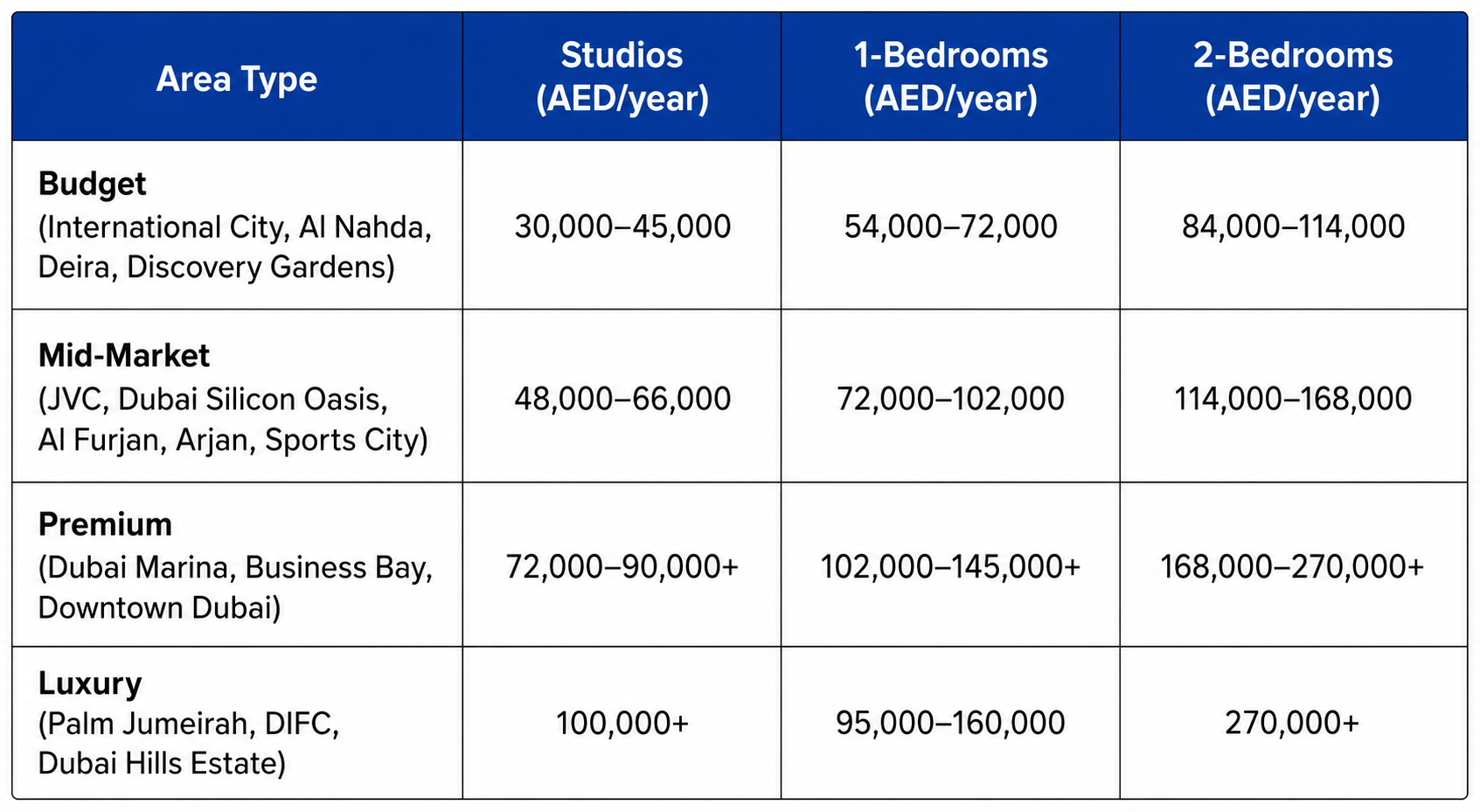
City-wide averages: Studios AED 62,700, one-beds AED 99,300, two-beds AED 168,500. Use these as your starting point. Actual deals vary by building quality and supply.
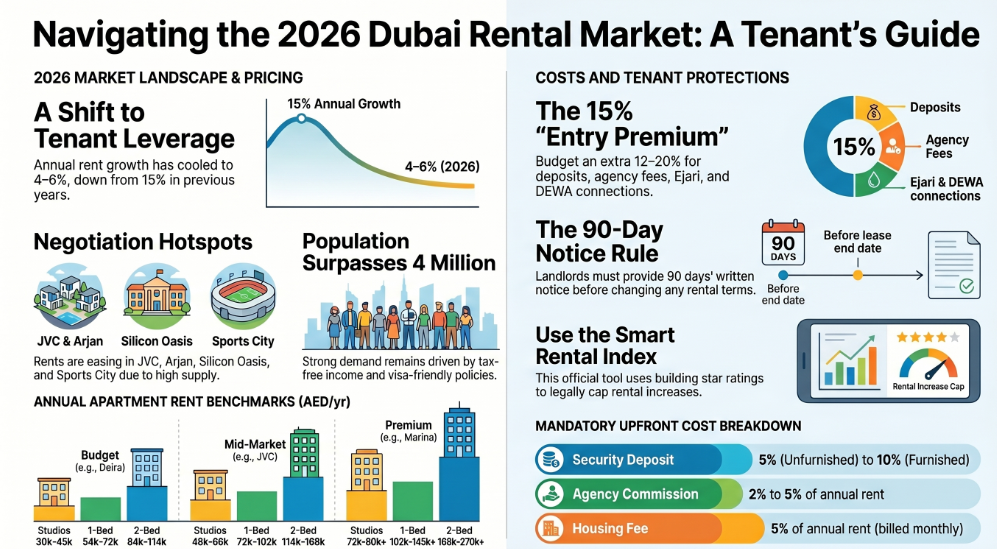
For the first time in three years, the market has genuinely shifted in tenants' favour, at least in certain pockets of the city. Annual rent growth across Dubai has pulled back to the 4% to 6% range in early 2026, a dramatic cooldown from the 15% or more seen in 2023 and 2024. The reason is supply. Developers who signed construction contracts during the boom years have been delivering, and delivering in volume. According to data from Prosper, approximately 120,000 new homes were projected for handover in Dubai in 2026 alone, adding to the tens of thousands already delivered in prior years.
This hasn't killed demand. Dubai's population has crossed four million, and the fundamentals that brought people here, zero personal income tax, strong infrastructure, visa-friendly policies, relative regional stability, remain firmly in place. But demand is no longer outrunning supply the way it was. The result is that tenants in many communities now have real negotiating leverage for the first time since the pandemic recovery. The important caveat is that this rebalancing is uneven. The apartment segment, especially in suburban and mid-market communities, has softened meaningfully. The villa segment has not. Ready-to-rent villas across family communities remain tight on supply and have held firm on price. Which side of that divide your search sits on will shape everything.
Studios are where the supply surge is most visible, and where tenants currently have the most room to push back on asking prices. At the affordable end, International City starts as low as AED 30,000 to AED 35,000 annually. It's functional, road-connected, and genuinely good value if keeping costs down is the priority. Discovery Gardens and Al Nahda sit in a similar range.
Budget areas like International City and Al Nahda offer one-bedrooms from AED 54,000 to AED 65,000. These areas have seen rent pressure ease with increased supply and are genuinely undervalued relative to their road connectivity.
The mid-market sweet spot runs through JVC, Dubai Silicon Oasis and Al Furjan, where studios typically land between AED 48,000 and AED 66,000 per year. New buildings in these communities are actively competing for tenants, which gives you real room to negotiate, especially in older stock trying to match newer towers.
JVC is the most talked-about mid-market option right now, and for good reason. A one-bedroom typically sits between AED 72,000 and AED 92,000 per year, and the area's improving retail and road access make it a consistent favourite among young professionals and couples. JLT offers similar pricing with the added benefit of Metro access and a stronger sense of urban energy.
Dubai Hills Estate tends to run AED 95,000 to AED 120,000 for a one-bedroom, a premium driven by its school options, green space and community feel. Business Bay straddles mid-market and premium, with a wide quality variation between towers that can make the same price feel very different depending on which building you land in.
In Dubai Marina and Business Bay, studios command AED 72,000 to AED 90,000 annually. You're paying for walkability, proximity to the Metro, and a lifestyle that genuinely differs from suburban Dubai. Whether that premium is worth it depends entirely on how you actually use the city.
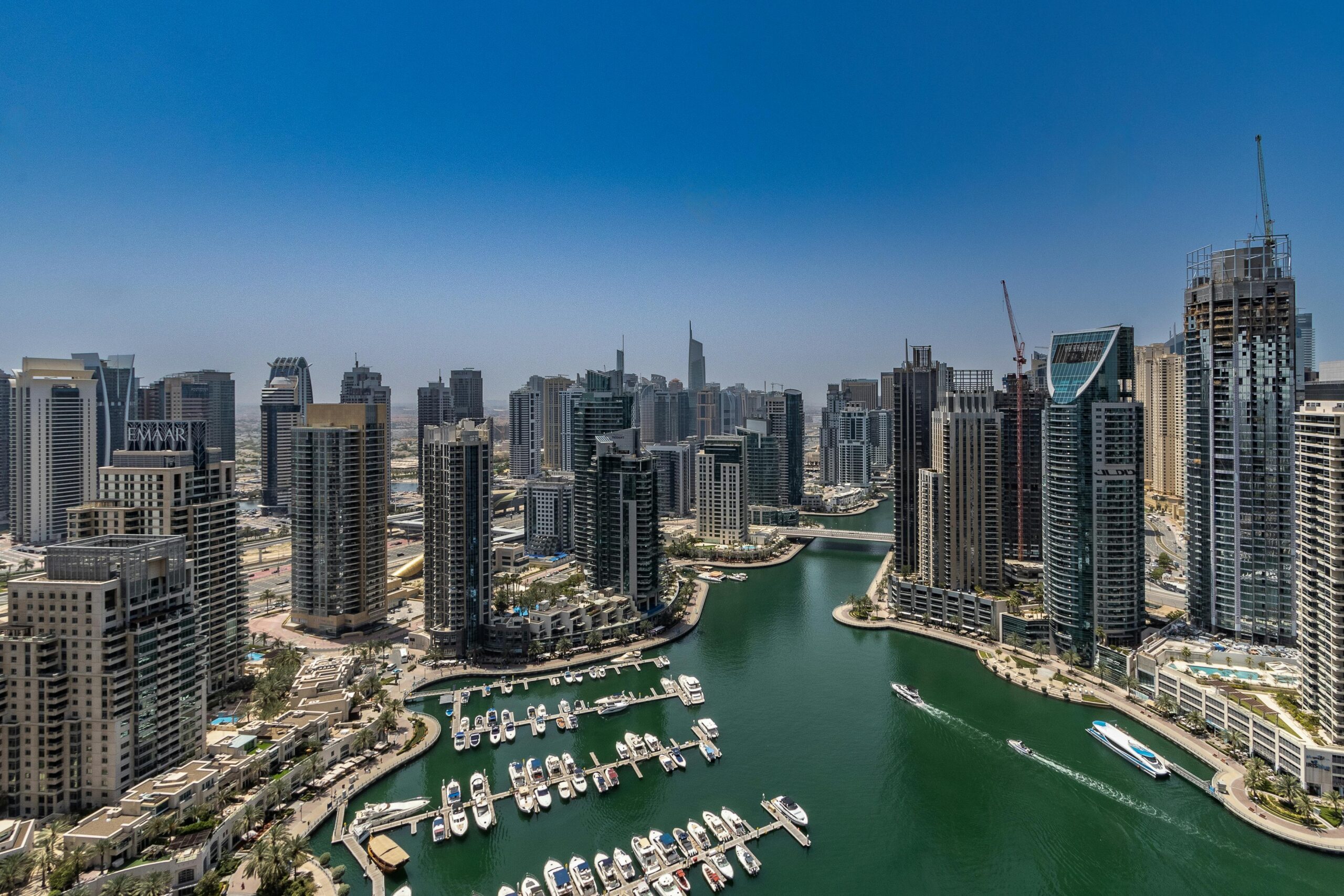
Dubai Marina remains one of the most in-demand rental addresses in the city, and the pricing reflects it. One-bedroom apartments in the Marina typically range from AED 95,000 to AED 130,000 per year, with sea-view units in newer towers sitting toward the upper end of that band. Studios in the Marina hover between AED 72,000 and AED 90,000. Two-bedrooms range from AED 150,000 to AED 195,000 annually, sometimes higher in premium waterfront buildings.
What you're paying for is real. The walking environment, the water, the concentration of restaurants, leisure and retail, and the proximity to JBR and Palm Jumeirah all justify a meaningful premium over comparable square footage in a suburban community. The trade-off is density, traffic particularly on weekends, and parking that can be genuinely stressful depending on your building. If your daily life revolves around the Marina or nearby areas, the premium often makes sense. If you're commuting across the city every morning, the same budget stretches considerably further elsewhere.
While most of the city has seen modest rent growth, four communities are bucking that trend in 2026. The reason, according to Alec James Smith, Head of Sales and Leasing at Savills Middle East, is supply rather than any weakness in demand.
"Areas such as JVC, Arjan, Dubai Silicon Oasis, Discovery Gardens and Sports City are experiencing more stable or slightly easing rents due to a significant volume of new stock becoming available," Smith told Time Out Dubai. "This has increased competition among landlords and given tenants more choice and negotiation power."
JVC: One-bedroom apartments average around AED 79,999 per year. Supply growth has been significant, and landlords of older buildings are having to compete with brand-new units to retain and attract tenants. If you're signing a new contract here, negotiate.
Arjan: A quieter community neighbouring Al Barsha and Dubai Science Park, Arjan is averaging around AED 78,000 per year for a one-bedroom. It's become increasingly popular with families and professionals who want calmer surroundings without sacrificing access to the wider city.
Dubai Silicon Oasis: A tech-focused, family-friendly community with parks, schools and a blend of residential and commercial use. One-bedrooms average around AED 65,000 per year, making it one of the better value mid-market options in the city right now.
Dubai Sports City: A family-oriented community set away from the centre, with one-bedrooms also averaging around AED 65,000 per year. Worth noting that there's limited public transport here, so a car is essentially required.
One important caveat Smith raised: if you're already renting in one of these areas, your renewal is unlikely to see a meaningful drop. Landlords are much more willing to negotiate on new contracts than on renewals. If you're an existing tenant, your leverage is getting a new quote from a competing building in the same area and presenting it at renewal time.
Bur Dubai occupies a unique position in Dubai's rental market. It's one of the city's oldest and most established districts, with a density of hotel apartments that offer monthly rental arrangements uncommon in most other areas.
Monthly rent for a hotel apartment in Bur Dubai typically runs between AED 3,500 and AED 7,000 per month depending on size, building quality and whether the unit is fully serviced. These figures translate to roughly AED 42,000 to AED 84,000 annualised, though the monthly format comes at a premium over equivalent annual contracts.
The appeal is flexibility. Hotel apartments in Bur Dubai are fully furnished, utilities are often bundled, and you're not locked into a 12-month commitment. For new arrivals testing the city before committing to an area, or professionals on extended project stays, this format makes practical sense. The location also has genuine advantages: strong Metro connectivity, proximity to Deira and old Dubai, and a dense everyday services infrastructure that more polished newer communities often lack.
The figure in the listing is not the figure that leaves your bank account. New tenants in Dubai consistently underestimate the real cost of entry, and the gap can be significant.
Here's what to budget for beyond the headline rent:
Security deposit: 5% of annual rent for an unfurnished property, 10% for furnished. On a AED 100,000 per year apartment, that's AED 5,000 to AED 10,000 upfront.
Agency commission: Typically 2% to 5% of annual rent, paid once at signing.
Ejari registration: Around AED 178 to AED 220 depending on whether you register online or through a trustee centre. This is mandatory. The Dubai Land Department requires all tenancy contracts to be registered through the Ejari system.
DEWA deposit: AED 2,000 for an apartment, refundable when you leave.
DEWA connection fee: From AED 100 plus applicable fees.
Municipal housing fee: 5% of your annual rent, billed monthly through your DEWA statement. The UAE government portal confirms this fee applies to all tenants and is not subject to VAT.
In practice, an apartment advertised at AED 100,000 per year will cost you AED 112,000 to AED 120,000 or more to actually move into and run through the first month. Budget accordingly before you fall in love with a listing.
Dubai's rental laws are genuinely tenant-protective. Most tenants simply don't know how to invoke them.
The 90-day notice rule: Your landlord must give you at least 90 days' written notice before the end of your contract if they intend to change the rental terms, including increasing the rent. Under Law No. 33 of 2008, an increase announced the week before your lease expires is very likely unenforceable. If you didn't receive 90 days' notice, you have grounds to reject the increase and renew at your current rate.
The legal increase caps: Decree No. 43 of 2013 sets clear limits on how much rent can legally increase at renewal, based on how far your current rent sits below the market average for your area. If your rent is within 10% of the market average, no increase is permitted. If it's 11% to 20% below average, the landlord can raise it by up to 5%. The gap widens from there, with a maximum permissible increase of 20% for properties priced more than 40% below market average.
The Dubai Smart Rental Index: This is your most practical tool as a tenant. The Dubai Land Department maintains a rating system that gives every registered building a one to five star score based on location, condition and amenities. Your building's rating directly determines its benchmark rent, meaning a poorly maintained building is legally capped at a lower amount than a well-kept one of similar size. Before agreeing to any renewal terms, check the official DLD rental calculator at dubailand.gov.ae. If your landlord's proposed increase exceeds the legal cap, reject it in writing, reference the relevant decree, and attach the calculator output. This is not aggressive, it's the process the law is designed for.
The process is more structured than many new arrivals expect, but once you understand the steps it's reasonably straightforward.
Start by setting a realistic total budget, not just the headline rent. Add 15% to whatever your annual rent figure is to account for the deposit, agency commission, Ejari, DEWA and the housing fee.
Search through licensed agencies or verified platforms. In Dubai, all real estate agents must hold a RERA (Real Estate Regulatory Agency) licence. You can verify any agent's credentials through the Dubai REST app or the DLD website.
When you find a property, visit it in person before committing. Check the building, the parking, the noise levels on a weekday, the actual commute to where you need to go, and the presence or absence of active construction nearby.
Once you agree terms, the landlord or agency will prepare a tenancy contract. Cheques are still the standard payment method in Dubai. Many landlords accept two to four post-dated cheques per year, though some still require a single annual cheque. The fewer cheques you offer, the more negotiating leverage you often have.
The contract must be registered through Ejari before it's legally valid. This is typically handled by the agency but confirm who is responsible before you sign. Once registered, you can connect DEWA, set up your utilities and move in.
There's no universally best area to rent in Dubai. There are areas that fit certain lives well and areas that don't. The mismatch is one of the most expensive mistakes tenants make.
If you're a young professional or couple who wants walkability, social infrastructure and Metro access, Dubai Marina, JLT, Business Bay and Downtown are where most people in this situation gravitate. Competition for well-priced one-bedrooms in these areas remains strong, and speed of application often matters as much as the price you offer.
If you're commuting to specific parts of the city every day, prioritise transport over postcode prestige. A poorly chosen area can cost you 1.5 to 2 hours of daily commute time. That's a real quality-of-life cost that no view compensates for. Al Barsha, JLT, and parts of JVC work well for people crossing to different parts of the city regularly.
If you're moving with a family, the calculus changes significantly. School proximity can be worth AED 20,000 to AED 30,000 per year in rent premium on its own, so identify your school first and work outward from there. Dubai Hills Estate, Arabian Ranches, Mirdif and Al Furjan dominate family rental demand for good reason: they offer space, greenery, community feel and reasonable school access in a single package.
If you want to test an area before buying, rent is genuinely the smarter play. Dubai can look very different inside a community versus on a map, and the same neighbourhood can feel completely different depending on which tower or street you're on. A 12-month rental is cheap research compared to a buying decision you regret.
Yes, you can. This surprises a lot of people, but there's no legal requirement to hold a UAE residency visa in order to sign a rental contract in Dubai.
In practice, landlords and agencies will typically ask for a valid passport and, if available, a visa page. Some landlords prefer tenants with residency visas as it signals longer-term commitment, and a small number of buildings or communities may have their own informal preferences. But legally, residency is not a barrier to renting.
Tourist visa holders, people in the process of obtaining residency, and those on remote work or freelance setups have all rented in Dubai under standard 12-month contracts. The contract still needs to be registered through Ejari, and all the standard costs apply regardless of your visa status.
If you're in the process of relocating and your residency paperwork is still being processed, this flexibility means you don't need to delay your housing search. Just be upfront with the agency about your situation and confirm the building has no specific residency requirements before you pay a deposit.
Across the city as a whole, a broad rent decline is unlikely. The structural demand that underpins Dubai's market, population growth, international appeal, visa-driven inflows, remains intact. What's happening instead is selective softening in specific communities where new supply has given tenants more negotiating power. Areas like JVC, Dubai Silicon Oasis, Arjan and Sports City are seeing stable or slightly easing rents. Premium and waterfront areas have largely held firm. If you're hunting in a supply-heavy mid-market community, you can likely negotiate below asking price. If you're targeting Downtown or Dubai Marina, don't bank on a discount.
The consensus among analysts going into 2026 is a market in transition from aggressive growth to measured maturity. Annual rent growth has pulled back to the 4% to 6% range citywide, down sharply from peaks of 15% or more in prior years. Sales prices have remained stronger, particularly for villas and off-plan units in established developers' portfolios. The long-term fundamentals, tax efficiency, infrastructure quality, visa policy, and political stability relative to comparable cities, continue to attract both residents and capital. Most forecasts point to continued but moderate growth through 2026, with the apartment segment remaining more subdued than the villa and luxury markets.
For investors, the highest rental yields in Dubai have consistently come from mid-market and high-density communities rather than the premium addresses. Areas like International City, Discovery Gardens, Dubai Silicon Oasis and JVC regularly generate gross yields in the 7% to 9% range, driven by strong tenant demand, relatively lower purchase prices and manageable service charges. Dubai Marina and Downtown Dubai, despite their premium rents, typically yield lower on a percentage basis because purchase prices are proportionally higher. Dubai Hills Estate sits in the middle ground, with yields typically in the 5% to 6% range, supported by strong family demand and school proximity. Yield data shifts with supply, so always verify against current DLD transaction records before making an investment decision.
The Dubai Smart Rental Index is the official tool used by the Dubai Land Department to regulate rental pricing across the emirate. Updated to reflect current market conditions, it assigns every registered building a rating from one to five stars based on location, building quality, amenities and condition. That star rating determines the legal benchmark rent for the property, which directly caps how much a landlord can charge and by how much they can increase rent at renewal. The index replaced the older flat-rate system and is designed to tie allowable rents to actual building quality rather than just area averages. Tenants can access the rental calculator at dubailand.gov.ae to check whether their current or proposed rent is in line with the legal benchmarks for their specific building. It's one of the most underused tools available to tenants in Dubai, and arguably the most powerful one.



Read Next
Stay ahead on money, banking, and business across the Middle East.
By clicking “Sign Up”, you accept our Terms of Service and Privacy Policy. You can opt-out at any time by visiting our Preferences page or by clicking "unsubscribe" at the bottom of the email.