
Non-residents can open a bank account in the UAE, but the options available, the minimum balances required, and whether you need to visit a branch in person all depend on the bank and the account type. In most cases, non-residents are offered savings or fixed deposit accounts, face stricter documentation requirements than residents, and will need to demonstrate a credible source of funds. If you are well-prepared, the process is manageable.
Can non-residents open a UAE bank account? Yes, but options are limited compared to residents. In most cases you will be offered a savings or fixed deposit account rather than a current account. Minimum balance requirements vary widely by bank and account tier, ranging from as low as AED 3,000 at some institutions to AED 500,000 or more for priority banking. Some banks require an in-person branch visit. Approval times can range from a few weeks to several months depending on your profile and the complexity of your application.
People open bank accounts in the UAE without residency for a number of legitimate financial reasons. The most common include receiving rental income from UAE property, collecting dividends from UAE-based businesses, investing in local stock markets such as the Dubai Financial Market or Abu Dhabi Securities Exchange, and accessing a stable and internationally connected banking system. The UAE dirham is pegged to the US dollar, which adds a layer of currency stability that appeals to international investors and savers. It is worth noting that holding funds in a UAE account does not provide tax benefits unless you are also a UAE tax resident.
In most cases, non-residents are offered savings or fixed deposit accounts. Current accounts are generally reserved for residents who hold an Emirates ID, though some banks may offer a current account to non-residents with a valid passport and UAE entry stamp depending on their internal policies. Corporate accounts take a different route. It is best to confirm directly with the bank what is available to you before beginning an application.
A savings account is the most common option for non-residents. Minimum balance requirements vary significantly between banks and account tiers. Some entry-level products have lower thresholds while others, particularly at premium or priority banking level, require significantly higher balances.
A priority banking account typically requires maintaining a higher minimum balance, often in the range of AED 500,000, but tends to have a faster approval process and may come with a broader range of services. The specific features available at this tier differ by bank.
Without an Emirates ID, access to cheque books and overdraft facilities is generally not available. This is worth factoring in if you expect to conduct financial transactions that typically rely on cheques, which remain in use for certain payments in the UAE.
Banks operating under the UAE anti-money laundering framework and related regulations, are required to verify that your intentions are legitimate. Be prepared to explain and evidence your purpose clearly, whether that is property investment, business activity, or another financial reason.
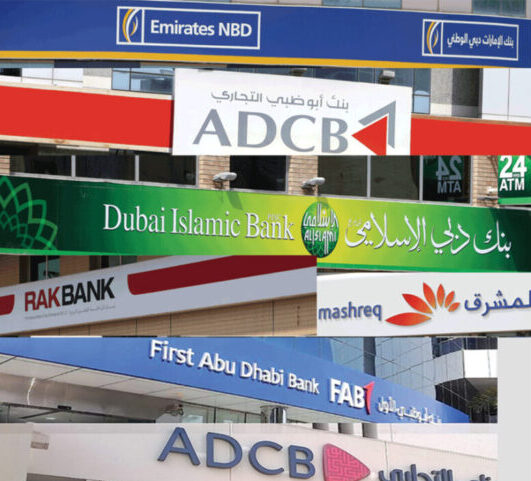
A number of banks in the UAE offer non-resident banking products or onboarding processes, including Emirates NBD, RAKBANK, Mashreq, Emirates Islamic, HSBC UAE, First Abu Dhabi Bank, Abu Dhabi Commercial Bank, and Dubai Islamic Bank, among others. Requirements, account types, and minimum balances differ between them, so it is worth contacting each one directly before committing to an application.
While requirements vary by bank, most will ask for a valid passport with a UAE entry stamp, proof of address in your home country such as a utility bill or bank reference letter, six months of bank statements, a reference letter from your home country bank, a CV or professional background summary, and documentation of your source of funds.
Some banks ask non-residents to meet in person as part of their onboarding process. Mashreq, for example, states that it would like to meet non-resident applicants in person. Other banks may offer alternative or remote processes for certain account types or client profiles. Confirm the process with your chosen bank before travelling.
Non-resident applications typically involve additional checks compared to resident applications. Approval timelines can vary from a few weeks to longer in more complex or higher-risk cases.
The deposit required will depend on the bank and the account tier you have applied for. Confirm this figure with the bank during your initial enquiry.
While requirements vary between banks, the following documents are commonly requested:
Banks may request additional documents after an initial compliance review depending on your individual profile.
Approval timelines for non-resident bank accounts in the UAE are generally longer than for residents, due to the additional compliance checks involved. In straightforward cases the process may take a few weeks, while more complex applications or higher-risk profiles can take considerably longer. The bank you choose and the account tier you apply for will both influence how quickly your application moves through the process.
Several UAE banks have non-resident banking products or dedicated onboarding processes for foreign applicants. These include Emirates NBD, RAKBANK, Mashreq, Emirates Islamic, HSBC UAE, First Abu Dhabi Bank, Abu Dhabi Commercial Bank, and Dubai Islamic Bank. This list is not exhaustive, and availability can change. Each bank has its own requirements, minimum balances, account features, and processing timelines. Contacting the bank directly is the most reliable way to understand what currently applies to your situation before beginning an application.
If you are in the process of applying for a UAE Golden Visa through property investment, having a local bank account may be relevant to part of that process. A fixed deposit in a UAE bank is one element associated with certain Golden Visa routes, but meeting all residency, documentation, and financial requirements set by the relevant UAE authorities is necessary. Opening a non-resident bank account alone does not advance or guarantee a Golden Visa application. If you are pursuing this route, seek specific legal or residency advice to understand the full requirements.
Fees vary between banks and account types. Most accounts are free to open. Monthly maintenance fees may apply if your balance falls below the required minimum, and the amount varies by institution. ATM withdrawals are generally free at your own bank's ATMs. Domestic transfers within the UAE and international transfers both carry fees that differ by bank, so it is worth reviewing the fee schedule of your chosen bank before opening an account.
If your primary need is international transfers, multi-currency spending, or managing money across borders, digital platforms such as Wise, Revolut, or N26 may be worth exploring. These platforms generally have fewer restrictions on international transactions and do not require large minimum balances. They are not UAE bank accounts and will not serve needs that require a local account such as receiving UAE rental income or trading on UAE stock markets, but they can be a practical complement to or alternative for cross-border financial management.
Yes. Visit visa holders can open a non-resident savings account at banks that offer this service. You will generally not have access to a cheque book or credit facilities, and minimum balance requirements apply. Some banks require you to be physically present in the UAE to complete the process, while others may have alternative arrangements depending on the account type.
This depends on the bank. Some banks now offer digital account opening for certain account types. Others, including Mashreq for its non-resident product, ask to meet applicants in person. Confirm the process with your chosen bank before assuming a fully remote application is possible.
Several banks offer non-resident accounts, including Emirates NBD, RAKBANK, Mashreq, HSBC UAE, FAB, DIB, and ADCB. The most suitable option depends on your balance level, country of origin, purpose for banking, and the specific features you need. Contact each bank directly to compare their current requirements and decide based on your own circumstances.
Most non-resident accounts require a minimum balance, though the amount varies significantly between banks and account tiers. Some products have lower entry thresholds than others. Zero balance accounts for non-residents are not a standard offering, but minimum balance requirements are not uniform across all banks, so it is worth enquiring directly.
For resident accounts linked to salary transfers, banks typically have minimum salary requirements. For non-resident accounts, there is generally no formal salary requirement, but you will need to demonstrate a credible source of funds and meet the minimum balance set by the bank.
This is a more complex situation. Banks will require proof of address somewhere in the world, a clear purpose for banking in the UAE, and a strong financial profile. It is not impossible, but applications of this nature are more likely to be considered through priority or private banking channels where the process is more personalised.



Read Next
Stay ahead on money, banking, and business across the Middle East.
By clicking “Sign Up”, you accept our Terms of Service and Privacy Policy. You can opt-out at any time by visiting our Preferences page or by clicking "unsubscribe" at the bottom of the email.